
Summary
- Yes, many vehicles require ADAS calibration after a collision repair in Texas, even for minor accidents.
- If sensors, cameras, bumpers, windshields, or alignment are affected, calibration is often necessary to restore safety systems.
- Skipping calibration can lead to inaccurate warnings, delayed braking, or disabled safety features.
- A proper repair includes scanning, OEM procedures, calibration when required, and final quality checks.
After a car accident, most drivers are focused on what they can see. Dents, scratches, broken lights, or paint damage.
But what many Texas drivers do not realize is that modern vehicles rely heavily on hidden safety systems. These systems may be affected even in a minor collision.
If you have recently had collision repair, you may be asking a simple question. Do I really need ADAS calibration?
The answer depends on your vehicle and the type of damage, but in many cases, the answer is yes. And it matters more than most people think.
What Is ADAS and Why Does It Matter?
ADAS stands for Advanced Driver Assistance Systems. These are the built-in safety features designed to help prevent accidents or reduce their severity.
Common systems include:
- Automatic emergency braking
- Lane departure warning
- Blind spot monitoring
- Adaptive cruise control
- Parking sensors
- Rear cross traffic alert
These systems rely on cameras, radar sensors, and computer modules that must be precisely aligned.
According to the National Highway Traffic Safety Administration, these technologies are designed to help drivers avoid crashes and improve overall road safety.
If those sensors are even slightly off after a collision, the system may not function correctly.
When Is ADAS Calibration Required After Collision Repair?
The short answer
ADAS calibration is required anytime a repair affects the position, angle, or function of a sensor or camera.
Common situations that require calibration
- Front or rear bumper repair or replacement
- Windshield replacement
- Mirror replacement
- Suspension or steering repairs
- Wheel alignment
- Frame or structural repairs
- Sensor removal or replacement
- Airbag deployment
Even a small fender bender can require calibration if it impacts sensor mounting areas.
This is why proper repair planning matters. At Grimes Paint & Body in Forney, TX, this is why repair planning matters. When we handle collision repair in Forney, the goal is not just a clean finish. The goal is a safe, complete, OEM-standard repair that gives customers confidence when they get back on the road.
What Happens If ADAS Calibration Is Skipped?
Your car may look perfect after repairs. But safety systems may not be working correctly.
Potential issues include:
- Delayed automatic braking
- Incorrect lane detection
- Blind spot systems missing nearby vehicles
- False warnings or alerts
- Disabled safety features
The Insurance Institute for Highway Safety explains that while ADAS features improve safety, they also make proper repair procedures more important.
Skipping calibration is not just a minor oversight. It can affect how your vehicle protects you and your family.
Cost of ADAS Calibration in Texas
What impacts cost?
ADAS calibration costs vary depending on:
- Vehicle make and model
- Number of systems involved
- Type of calibration required
- Severity of damage
- Whether alignment is needed
Typical expectations
Calibration is not a flat-rate service. Some vehicles require simple recalibration, while others require multiple systems to be reset.
While it can add to the cost of collision repair, it is not an optional add-on when required by the manufacturer.
A trustworthy shop should clearly explain:
- Why calibration is needed
- What systems are affected
- How it connects to your repair
Transparency is key.
Static vs Dynamic Calibration
Static Calibration
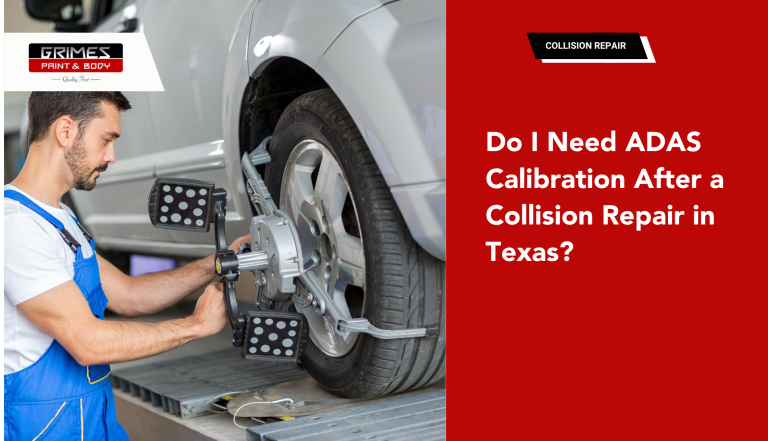
Performed inside the shop using specialized equipment and targets.
Requires:
- Level floor
- Controlled environment
- Exact measurements
Dynamic Calibration
Performed while driving the vehicle under specific conditions.
Requires:
- Clear road markings
- Specific speeds
- Manufacturer-defined procedures
Some vehicles require one type. Others require both.
Organizations like I-CAR emphasize that understanding calibration procedures is now required in modern collision repair.
OEM vs Aftermarket Approach to Calibration
OEM Approach
- Follow the manufacturer’s repair procedures
- Uses correct calibration steps
- Ensures systems perform as designed
Shortcut Approach
- Skips calibration when possible
- Assumes systems are “fine”
- Relies only on warning lights
The difference is simple. One prioritizes safety. The other prioritizes speed or cost.
This is why auto body repair at Grimes Paint & Body is focused on OEM procedures and doing the job right the first time.
ADAS Calibration and Windshield Replacement
Many drivers are surprised to learn that windshield replacement can require calibration.
That is because forward-facing cameras are often mounted near the windshield.
Safelite explains that recalibration is frequently required after replacement because these systems control important safety features.
If your collision repair includes glass replacement, calibration should always be evaluated.
Reviews and Real-World Insight
Across the industry, technicians and repair professionals consistently point to ADAS as one of the biggest changes in collision repair.
Drivers expect their vehicles to protect them. But that protection depends on proper repair procedures.
At Grimes Paint & Body, the focus is not just on fixing visible damage. It ensures the vehicle is safe, functional, and properly restored.
That means:
- Pre-repair scanning
- OEM repair procedures
- Calibration when required
- Post-repair verification
What Questions Should You Ask Your Body Shop?
Before choosing a shop in Forney or the DFW area, ask:
- Do you perform pre- and post-scans?
- How do you determine if calibration is needed?
- Do you follow OEM procedures?
- Will you document calibration for insurance?
- What happens if calibration is skipped?
FAQs About ADAS Calibration
Q: Do I need ADAS calibration after collision repair in Forney, TX?
A: In many cases, yes. If your repair involves areas where sensors or cameras are located, such as bumpers, windshields, mirrors, or suspension components, calibration is often required. Even minor accidents can slightly shift these components, which can affect how your safety systems respond. The only reliable way to know is through proper scanning and reviewing OEM repair procedures.
Q: How much does ADAS calibration cost in Texas?
A: The cost can vary depending on your vehicle’s make, model, and how many systems need to be calibrated. Some vehicles may only require a single calibration, while others may need multiple system resets. It is usually included as part of the overall collision repair estimate rather than a separate flat fee. A reputable shop will explain the cost and why it is necessary.
Q: Can I skip ADAS calibration if my car drives fine?
A: No. Just because your vehicle drives normally does not mean the safety systems are functioning correctly. ADAS features operate in the background, and even small misalignments can impact their accuracy. Skipping calibration can increase the risk of system failure when you need it most.
Q: Does insurance cover ADAS calibration?
A: In many cases, insurance will cover ADAS calibration if it is required as part of a proper collision repair. However, approval can depend on documentation and the specific policy. A shop that follows OEM procedures and provides clear documentation can help support the claim and explain the necessity to the insurer.
Q: How long does ADAS calibration take?
A: Timing depends on the type of calibration required. Some static calibrations can be completed within a few hours, while dynamic calibrations may require road testing under specific conditions. If multiple systems are involved or if additional repairs like alignment are needed, it may take longer. Your repair shop should provide a timeline based on your specific vehicle.
Q: What is the difference between scanning and calibration?
A: Scanning is the process of checking your vehicle’s computer systems for error codes, communication issues, or system faults before and after repairs. Calibration is the process of adjusting sensors and cameras so they function according to manufacturer specifications. Both steps are essential for a complete and safe repair.
Q: Does windshield replacement require calibration?
A: Often, yes. Many vehicles have forward-facing cameras mounted near or on the windshield. If the glass is replaced, that camera may need recalibration to ensure features like lane departure warning and automatic emergency braking work correctly. Skipping this step can lead to inaccurate readings or system errors.
Q: Are all body shops equipped to handle ADAS calibration?
A: No. Not every shop has the equipment, training, or space required to perform ADAS calibration properly. Some shops handle it in-house, while others partner with specialists. The important thing is that the shop follows manufacturer guidelines and ensures the calibration is completed and documented correctly.
Get a Safe, Proper Repair You Can Trust
If your vehicle has been in an accident, do not assume everything is fine just because it looks good. What you can’t see matters just as much as what you can.
ADAS calibration is an important part of today’s collision repair process. These systems are designed to help protect you, your passengers, and others on the road. If they are not properly calibrated after a repair, they may not respond the way they should in a real-world situation.
At Grimes Paint & Body, we take that responsibility seriously. Every repair is approached with a focus on safety, OEM procedures, and doing the job right the first time. From pre-repair scanning to final quality checks, our goal is to make sure your vehicle is not just repaired, but truly restored.If you have questions about your repair or want a professional evaluation, contact Grimes Paint & Body today to schedule an estimate and get clear, honest answers about your vehicle. You can visit us in person at 11804 N Profit Row, Forney, TX 75126 to speak with our team and get started on your repair.
