SUMMARY
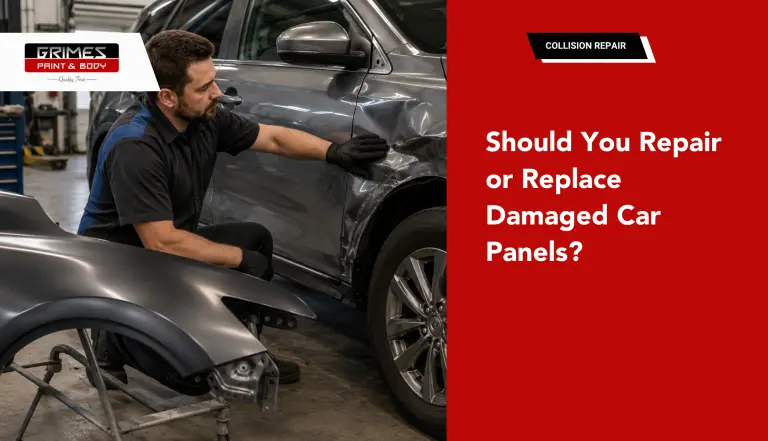
- A damaged car panel does not automatically need replacement. Many dents, creases, and localized areas of collision damage can be repaired.
- Replacement is more likely when the panel has severe stretching, tears, cracks, damaged mounting points, structural involvement, or manufacturer restrictions that prohibit repair.
- The decision depends on the type of panel, material, damage location, severity, previous repairs, access, labor involved, and OEM repair procedures.
- Exterior panels such as fenders and doors often offer more repair options than structural components.
- High-strength steel, ultra-high-strength steel, aluminum, and other advanced materials may have strict repair limitations.
- Paintless Dent Repair may preserve the original panel and factory finish when the dent is suitable, and the paint remains intact.
- Repairing the original panel can sometimes avoid unnecessary disruption of factory welds and corrosion protection.
- Replacing a panel can be the better option when the original part cannot be restored reliably or when the manufacturer requires replacement.
- Grimes Paint & Body, located at 11804 N Profit Row, Forney, TX 75126, United States, provides professional collision repair, auto body repair, and Paintless Dent Repair for damaged vehicle panels.
After an accident, one of the most common questions drivers ask is:
Can this panel be repaired, or does it need to be replaced?
At first glance, the answer may seem obvious. A small dent looks repairable, while a heavily crushed panel looks like a replacement candidate.
In reality, the decision can be more complicated.
A relatively large dent in the middle of an exterior panel may sometimes be restored successfully, while a smaller crease near a structural reinforcement, factory seam, or high-strength component may require replacement.
Professional technicians consider much more than appearance. They evaluate the panel material, severity and location of damage, metal stretching, accessibility, previous repairs, corrosion protection, and manufacturer-specific repair procedures.
For drivers in Forney, TX, understanding these factors makes it easier to see why repair recommendations can vary from one damaged panel to another.
Grimes Paint & Body, located at 11804 N Profit Row, Forney, TX 75126, United States, provides professional auto body repair and collision repair for vehicles with damaged body panels.
What Factors Determine Whether a Car Panel Can Be Repaired?
Technicians typically consider several factors together.
These may include:
- Panel material
- Damage severity
- Damage location
- Metal stretching
- Cracks or tears
- Structural involvement
- Access to the damaged area
- Previous repairs
- Corrosion
- OEM repair restrictions
- Repair labor
- Long-term durability
The same amount of visible damage can lead to different repair decisions depending on where it occurs and what the panel is made from.
For example, a dent in a bolt-on steel fender may offer more repair flexibility than damage affecting a high-strength structural component.
That is why professional repair planning should be based on the actual vehicle rather than a universal rule.
When Can a Damaged Panel Usually Be Repaired?
Repair may be appropriate when the original panel can be restored without compromising its intended fit, function, or long-term durability.
Examples may include:
- Minor dents
- Moderate exterior-panel damage
- Certain creases
- Localized collision damage
- Surface scratches
- Some hail dents
Traditional body repair may involve:
- Metal reshaping
- Surface correction
- Sanding
- Primer
- Refinishing
When the factory paint is still intact and the dent is suitable, Paintless Dent Repair may also be an option.
Repairing the original panel can be beneficial when it avoids unnecessary replacement work, and the panel can still be restored properly.
When Is Panel Replacement More Likely?
Replacement may be recommended when the damage is too severe or when the manufacturer does not permit repair.
Common reasons can include:
- Severe metal stretching
- Tears
- Cracks
- Major deformation
- Damaged factory weld areas
- Structural damage
- Extensive corrosion
- Heavily damaged mounting points
- Multiple previous repairs
The decision should not be based only on whether the technician can physically straighten the panel.
A component may be technically possible to reshape while still being inappropriate to repair under the manufacturer’s procedure.
That distinction is particularly important on newer vehicles.
Why Does Damage Location Matter?
Where the damage occurs can be as important as how large it is.
A dent in the middle of a door or fender may be easier to restore than damage near:
- Structural seams
- Panel edges
- Body lines
- Factory welds
- Reinforcements
- Attachment points
- Crush zones
Damage near these areas may affect more than the visible outer skin.
Technicians may need to determine whether the collision also affected:
- Inner structures
- Mounting points
- Adhesive bonds
- Adjacent panels
- Reinforcements
This is why a small but sharply concentrated impact can sometimes require more extensive repair than a broad shallow dent.
Why Does the Material of the Panel Matter?
Modern vehicles use many different materials.
Technicians may encounter:
- Mild steel
- High-strength steel
- Ultra-high-strength steel
- Aluminum
- Plastic
- Composite materials
Each material responds differently to collision forces and repair methods.
Some may have restrictions involving:
- Heating
- Straightening
- Sectioning
- Welding
- Replacement
A technique that works on mild steel may not be appropriate for ultra-high-strength steel or aluminum.
Professional collision repair therefore requires identifying the material before deciding how to restore it.
Can High-Strength Steel Be Repaired?
Sometimes.
It depends on:
- Steel grade
- Component
- Damage severity
- Location
- OEM procedures
Some high-strength steel components permit limited straightening or repair.
Others have restrictions that require replacement once certain types of damage occur.
This is one reason modern collision technicians use vehicle-specific repair information rather than relying only on general bodywork experience.
The I-CAR OEM Technical Information Matrix provides collision professionals with manufacturer-specific information covering body materials and repair procedures.
What About Ultra-High-Strength Steel?
Ultra-high-strength steel may have stricter repair restrictions because it is commonly used in important structural areas.
Manufacturers may limit:
- Heat use
- Straightening
- Sectioning
- Welding procedures
A relatively small crease in one of these components can therefore result in replacement even if the visible damage looks minor.
This is another example of why damage size alone does not determine repairability.
Can Aluminum Panels Be Repaired?
Yes, depending on the panel and damage.
Aluminum requires different repair techniques from conventional steel.
Technicians may need to consider:
- Metal stretching
- Work hardening
- Heat restrictions
- Dedicated tools
- Contamination control
- OEM requirements
Some aluminum damage can be restored successfully.
Other damage may require replacement because the panel has stretched too severely or the manufacturer limits repair.
The important point is that aluminum repair should not be approached exactly like steel repair.
What Does Metal Stretching Mean?
When a panel receives collision force, the metal may not simply bend. It can stretch.
That means the damaged section has effectively changed in surface area.
Technicians evaluate:
- Dent depth
- Crease severity
- Impact intensity
- Material
- Panel shape
Minor stretching may sometimes be corrected.
Severe stretching can make it difficult to return the panel to its original contour and stability.
A heavily stretched panel may therefore be a stronger replacement candidate even if it remains physically attached to the vehicle.
Does a Sharp Crease Mean the Panel Must Be Replaced?
Not necessarily.
A sharp crease is generally more difficult to repair than a smooth dent because the deformation is concentrated into a narrow area.
Technicians consider:
- Depth
- Metal stretching
- Paint damage
- Material
- Location
- Accessibility
Some creases can still be professionally restored.
Others may involve too much stretching or occur in areas where the manufacturer restricts repair.
A photograph alone may not reveal enough information to make that decision confidently.
Can Paintless Dent Repair Save the Original Panel?
Yes, for suitable damage.
Paintless Dent Repair is designed to restore certain dents without conventional body filler or repainting.
It is most appropriate when:
- Factory paint remains intact
- Dent is accessible
- Metal is not severely stretched
- Damage is relatively shallow
- Panel material supports the procedure
Grimes Paint & Body offers Paintless Dent Repair for qualifying dents.
PDR can preserve:
- Original panel
- Factory finish
- Existing paint system
However, it is not appropriate for every collision-damaged panel.
When Is Paintless Dent Repair Not the Right Choice?
PDR may not be appropriate when:
- Paint is cracked
- Paint is missing
- Metal is torn
- Dent is extremely sharp
- Metal is severely stretched
- Structural damage exists
- Access is limited
In those situations, conventional body repair or panel replacement may be more appropriate.
The goal is not to force every dent into a PDR repair.
The technician should choose the method that best fits the actual condition of the panel.
Can Hail-Damaged Panels Be Repaired Instead of Replaced?
Often, yes.
Many hail dents can be repaired using PDR when:
- Paint remains intact
- Dents are suitable
- Metal is not overly stretched
- Panel access is possible
However, severe hail can produce:
- Hundreds of dents
- Sharp impacts
- Cracked paint
- Stretched metal
At some point, replacement may become more practical depending on labor, damage severity, and panel condition.
Each panel should be evaluated individually rather than assuming an entire vehicle needs the same repair method.
Can a Door Panel Be Repaired?
Often.
Door damage may be repairable when the collision affects primarily the exterior skin, and the underlying structure remains sound.
However, doors contain more than the visible exterior panel.
They may include:
- Reinforcements
- Window components
- Wiring
- Locking mechanisms
- Side-impact structures
Possible signs of additional damage include:
- Door not closing correctly
- Window operating differently
- Changed panel gaps
- Wind noise
- Lock problems
If internal structures are affected, the repair may become more extensive.
Can a Fender Be Repaired?
Yes, many damaged fenders can be repaired.
Technicians evaluate:
- Dent depth
- Creases
- Metal stretching
- Damage near mounting points
- Paint condition
- Adjacent headlight alignment
Because many fenders are bolt-on parts, replacement can also be relatively straightforward compared with welded body panels.
That does not mean a fender should automatically be replaced.
If the original panel can be restored efficiently and properly, repair may make more sense.
What About Quarter Panel Damage?
Quarter panels can be more complex because they are commonly welded into the body structure.
Replacing one may involve:
- Cutting
- Welding
- Adhesives
- Seam restoration
- Corrosion protection
- Refinishing
In some situations, repairing the original quarter panel can preserve more factory welds and reduce disruption to surrounding structures.
In other cases, damage may be too severe, and replacement becomes necessary.
This is why the repair-versus-replace decision should consider how invasive each option is, not simply whether a replacement panel exists.
Why Can Repairing the Original Panel Be Better?
When appropriate, repairing the original panel can preserve more factory construction.
Potential advantages may include:
- Original panel remains installed
- Fewer factory welds disturbed
- Less adjacent disassembly
- Less disruption of corrosion protection
However, these benefits only matter when the panel is truly repairable.
The original part should not be preserved at the expense of repair quality.
Why Can Replacement Be the Better Choice?
Replacement may be better when the original panel:
- Is severely stretched
- Has torn metal
- Cannot hold the proper shape
- Has significant previous repairs
- Is structurally compromised
- Must be replaced under OEM procedures
In these situations, continuing to reshape the original panel may require excessive labor and still not produce the best result.
Replacement can provide a more efficient and durable path when the damaged part is no longer a good repair candidate.
Is Repair Always Less Expensive Than Replacement?
No.
Repair can involve many labor hours.
Costs may include:
- Metalworking
- Surface correction
- Body filler when appropriate
- Sanding
- Primer
- Refinishing
Replacement can involve:
- New panel
- Removal
- Installation
- Welding or fastening
- Corrosion protection
- Refinishing
Sometimes repairing the original panel is less expensive.
Sometimes replacement is more practical.
The best decision should balance repairability, OEM procedures, labor, parts cost, and long-term quality.
Can Insurance Influence Whether a Panel Is Repaired or Replaced?
Insurance companies may review the estimate and determine what they will pay under the claim.
However, the technical repair recommendation should still be based on the vehicle and damage.
The repair facility may document:
- Panel condition
- OEM procedures
- Repair labor
- Replacement requirement
- Hidden damage
If the insurer and repair facility disagree, they may discuss the operation and supporting documentation.
The insurer handles coverage and payment decisions. The body shop determines what it believes is necessary to repair the vehicle correctly.
Can Hidden Damage Change the Repair Decision?
Yes.
A panel may initially appear repairable.
After disassembly, technicians could discover:
- Inner-panel deformation
- Broken mounting points
- Reinforcement damage
- Wiring problems
- Structural damage
That additional information can change the recommendation.
For example, what looked like a simple fender dent may involve damage to mounting areas behind it.
This is why professional collision repair often includes deeper inspection after exterior components are removed.
Why Can the Repair Estimate Change After Disassembly?
The initial estimate is based on damage technicians can identify at that time.
Once the vehicle is disassembled, newly visible damage may require:
- Additional parts
- Additional labor
- Structural operations
- Refinishing
- Diagnostic work
The repair facility may then prepare a supplemental estimate.
This does not automatically mean the first estimate was wrong.
Some damage is simply inaccessible before disassembly.
Why Does Previous Bodywork Matter?
A previously repaired panel may contain:
- Body filler
- Prior welds
- Extra paint layers
- Previous corrosion
- Earlier distortion
These conditions can affect whether another repair is practical.
A technician may begin evaluating a small dent and discover extensive previous filler beneath the finish.
At that point, replacement may become more attractive than stacking another repair on top of older work.
Previous repairs do not automatically require replacement, but they are part of the overall assessment.
Why Is Corrosion Protection Important?
Collision repair can disturb the coatings that protect body panels from corrosion.
These may include:
- Primer
- Seam sealer
- Cavity wax
- Undercoating
- Other protective materials
When a panel is repaired or replaced, applicable corrosion protection needs to be restored.
This is particularly important when:
- Welding
- Cutting
- Replacing welded panels
- Repairing exposed steel
A panel can look excellent from outside while still needing protection in hidden areas behind the finished surface.
Why Do OEM Repair Procedures Matter?
OEM repair procedures can specify:
- Whether a component may be repaired
- Whether heat is allowed
- Where sectioning may occur
- Which joining method is required
- Whether replacement is mandatory
The I-CAR Repairability Technical Support portal provides access to manufacturer-specific repair information used throughout the collision repair industry.
This information matters because two similar-looking panels on different vehicles may have completely different repair limitations.
Can Repairing or Replacing a Panel Affect ADAS?
Potentially.
Modern vehicles may place:
- Radar sensors
- Parking sensors
- Cameras
- Wiring
in or near body panels and bumpers.
A repair can therefore involve more than bodywork.
Depending on the vehicle, technicians may need to consider:
- Sensor removal
- Wiring
- Diagnostic scanning
- Calibration
The National Highway Traffic Safety Administration explains that driver-assistance technologies rely on cameras, radar, and other sensors positioned throughout modern vehicles.
The requirement should be based on the specific vehicle and repair procedure.
How Does Paint Matching Fit Into Panel Repair or Replacement?
Whether the panel is repaired or replaced, refinishing is commonly part of the process when the paint is damaged.
Professional refinishing can involve:
- Surface preparation
- Primer
- Color matching
- Basecoat
- Clear coat
- Blending where appropriate
- Final inspection
A new replacement panel still needs to be refinished to match the vehicle.
Likewise, a repaired panel requires proper surface preparation before color is applied.
This is why paint work should be considered part of the full repair rather than a separate cosmetic afterthought.
Can an RV Panel Be Repaired the Same Way?
Not necessarily.
RVs can use different:
- Body materials
- Panel construction
- Finishes
- Attachment methods
than passenger vehicles.
Grimes Paint & Body provides RV repair for appropriate body and collision damage.
The repair-versus-replace decision on an RV should therefore be based on the construction of that particular vehicle rather than techniques normally used on a sedan or pickup.
What Questions Should You Ask Before Approving Panel Replacement?
Useful questions include:
- Why can’t the original panel be repaired?
- What material is the panel made from?
- Has the metal stretched?
- Is there hidden damage?
- Does the manufacturer require replacement?
- Is the panel structural?
- Will factory welds be disturbed?
- How will corrosion protection be restored?
- Will adjacent panels need refinishing?
- Could sensors or electronics be affected?
A professional body shop should be able to explain the reasoning behind the repair plan.
Drivers can also request an estimate from Grimes Paint & Body to better understand the recommended repair approach.
Frequently Asked Questions
Is it better to repair or replace a damaged car panel?
Neither option is always better. The right choice depends on damage severity, material, location, accessibility, structural involvement, OEM requirements, and long-term repair quality.
Can a badly dented panel still be repaired?
Sometimes. A large dent may still be repairable if the metal has not stretched excessively and the manufacturer permits the repair.
Does a cracked or torn panel need replacement?
Often, significant cracking or tearing makes replacement more likely, but the technician should evaluate the exact component, material, and OEM procedures.
Can Paintless Dent Repair save the original panel?
Yes, when the paint remains intact and the dent is appropriate for PDR.
Can high-strength steel panels be repaired?
Some can be repaired within manufacturer limitations, while others have restrictions that require replacement.
Can hidden damage change whether a panel is repaired or replaced?
Yes. Damage behind the exterior panel may not become visible until the vehicle is disassembled.
Does panel replacement always cost more?
No. Extensive repair labor can sometimes make replacement more practical, while welded panel replacement can sometimes be much more involved than repairing the original panel.
Where can I have damaged body panels evaluated in Forney, TX?
Grimes Paint & Body provides professional collision and auto body repair at 11804 N Profit Row, Forney, TX 75126, United States.
Damaged Car Panel? Get a Professional Repair-or-Replace Assessment in Forney, TX
Choosing between repairing and replacing a damaged vehicle panel requires more than looking at the size of the dent. Technicians need to consider the panel material, location of impact, metal stretching, structural involvement, previous repairs, accessibility, corrosion protection, and manufacturer-specific procedures before recommending the appropriate method.
If your vehicle has a damaged door, fender, quarter panel, hood, bumper, or another body component, visit Grimes Paint & Body at 11804 N Profit Row, Forney, TX 75126, United States. The team provides professional auto body repair, collision repair, and Paintless Dent Repair to determine whether the original panel can be properly restored or whether replacement is the better repair strategy.
