
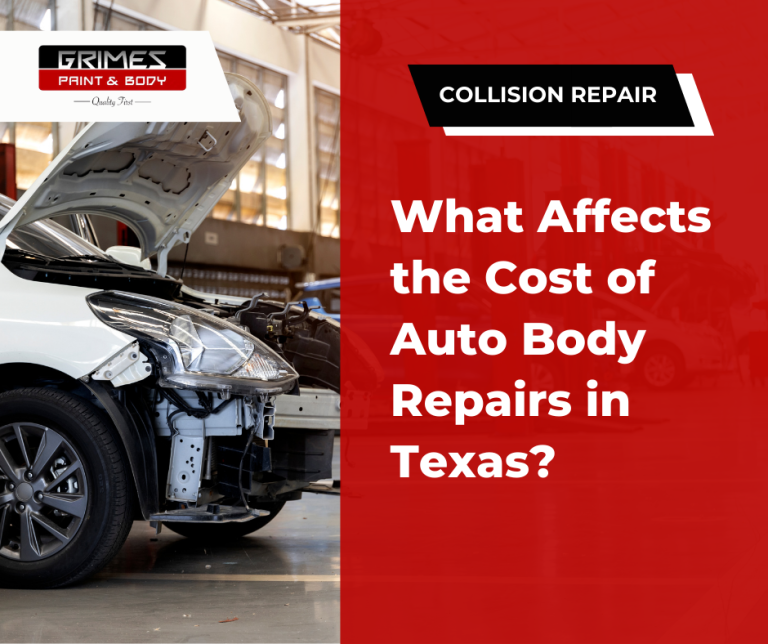
If you’ve been in an accident in Texas, one of the first questions that comes to mind is: “How much is this going to cost me?” Auto body repairs can range from a few hundred dollars for minor cosmetic work to several thousand for major collision damage—especially on newer vehicles with advanced safety systems.
The truth is, there is no single “average” price that fits every repair. Instead, the cost of auto body repairs in Texas depends on several key factors: the extent of the damage, the type of vehicle you drive, the quality of parts used, how your insurance policy is written, and whether your shop follows OEM repair procedures.
At Grimes Paint & Body in Forney, we believe you deserve clear, honest explanations of what goes into your estimate—line by line, no surprises and no shortcuts.
Want a clear, transparent estimate?
Request your free collision repair estimate today or call (469) 728-7210 to talk with our team about your repair options in Texas.
Why Auto Body Repair Costs Vary So Much
Two cars can be in what looks like the “same” accident and end up with very different repair bills. That’s because there’s a lot happening beneath the surface:
- Modern vehicles are built with high-strength steels, aluminum, and complex structures.
- Safety features like airbags, crash sensors, and ADAS (Advanced Driver Assistance Systems) must be inspected, reset, or recalibrated.
- OEM procedures may require specific parts and steps to keep your vehicle safe in a future collision.
Shops that skip these steps might offer a lower price—but at the cost of your safety, your warranty, and your vehicle’s value. At Grimes, we focus on proper, OEM-standard repairs, not just the cheapest possible fix.
Factor #1: The Type and Severity of Damage
The most obvious driver of cost is how badly your car is damaged.
Minor cosmetic damage
Examples:
- Scratches or scuffs on a bumper
- A small dent from a parking lot tap
- Minor paint damage without panel distortion
These repairs are usually on the lower end of the cost spectrum because:
- There’s no structural damage.
- There may be little or no need to remove and reinstall parts.
- ADAS systems and sensors are generally unaffected.
Moderate collision damage
Examples:
- Crumpled fender
- Damaged bumper with broken brackets
- Headlight or taillight damage
- Some inner structure or reinforcement affected
Here, costs increase because:
- More panels and parts need repair or replacement.
- There’s more labor—disassembly, bodywork, refinishing, and reassembly.
- Additional diagnostics and scanning may be needed.
Major structural damage
Examples:
- Frame or unibody damage
- Severe front- or rear-end collision
- Multiple panels and systems affected
This level of damage is more complex and time-consuming. Repairs can include:
- Frame or unibody straightening using precise measuring systems.
- Replacement of structural components according to OEM procedures.
- Multiple paint operations, blending, and corrosion protection steps.
- Extensive pre- and post-repair scanning and ADAS calibration.
This is where choosing a shop that specializes in collision repair in Forney, TX really matters. Cutting corners on structural repairs can seriously compromise your safety in any future accident.
Factor #2: The Parts Used (OEM vs Aftermarket vs Recycled)
One of the biggest cost variables is the type of parts installed on your vehicle.
OEM (Original Equipment Manufacturer) parts
- Designed by your vehicle’s manufacturer
- Built to match the original fit, function, and crash performance
- Typically more expensive than aftermarket options
At Grimes Paint & Body, OEM parts are the gold standard whenever possible because they support:
- Proper airbag and sensor performance
- Correct crumple-zone behavior
- Better long-term durability and fit
Aftermarket parts
- Made by third-party manufacturers
- Often cheaper, but quality can vary
- Fit and finish may not match OEM exactly
Some insurance companies push for aftermarket parts to save money. We take the time to review your estimate, explain the part types being used, and advocate for OEM parts where they matter most for safety and performance.
Recycled or salvage parts
- Used OEM parts sourced from other vehicles
- Can be appropriate for certain non-structural components
- Must be carefully inspected for damage or corrosion
In some situations, recycled OEM parts can be a good balance between cost and quality. The key is making sure they are used correctly and safely, not just as a way to cut corners.
Factor #3: Labor, Materials, and Paint
The cost of auto body repair isn’t just parts—it’s also labor and materials.
Labor hours
Collision repair involves several skilled operations:
- Disassembly and reassembly
- Body and metal work
- Frame or structural repair
- Plastic repair
- Prep and paint
- Detailing and quality control
Each step is billed in labor hours based on the time it takes to properly complete the work. Shops that rush or reduce labor time may be skipping important OEM-required steps.
Paint and materials
High-quality refinishing involves:
- Primers, sealers, and clear coats
- Color mixing and matching
- Sanding, masking, and blending into adjacent panels
At Grimes, we use professional-grade paint systems in our AccuDraft downdraft paint booth, which allows for consistent, durable finishes that match your original color as closely as possible.
Factor #4: Your Vehicle Make, Model, and Technology
Not all vehicles cost the same to repair. Some reasons:
- Luxury or high-performance brands often have higher parts and paint costs.
- Trucks and SUVs can have larger panels and more complex structures.
- Newer vehicles carry more sensors, cameras, and modules that need scanning and calibration.
For example, a modern bumper may house:
- Parking sensors
- Blind-spot monitors
- Rear cross-traffic alerts
- Surround-view cameras
Removing and reinstalling that bumper correctly—and making sure everything works afterward—takes more time and specialized equipment than a simple, older bumper with no electronics.
Factor #5: OEM Procedures and Safety Systems (ADAS)
One of the most overlooked cost drivers is whether a shop follows OEM repair procedures.
Proper collision repair in Texas may require:
- Pre- and post-repair scanning to check for hidden trouble codes.
- Calibration of ADAS features like lane-keep assist, automatic emergency braking, and adaptive cruise control.
- Specific weld types, adhesives, or repair limits on high-strength steel and aluminum.
Skipping these steps can lower the estimate—but it also puts you and your passengers at risk. At Grimes, we treat OEM procedures as non-negotiable because your vehicle’s structure and safety systems must perform as designed in any future crash.
Factor #6: Insurance Coverage, Deductibles, and Policy Limits
Your out-of-pocket cost depends heavily on how your policy is written.
Key elements:
- Deductible: The amount you pay before insurance kicks in.
- Coverage type: Liability, collision, and comprehensive all work differently.
- Repair vs. total loss thresholds: For severe damage, your insurer may decide to total the vehicle instead of repairing it.
At Grimes Paint & Body, we:
- Help you understand your estimate and insurance paperwork.
- Explain which repairs are covered and which costs might be your responsibility.
- Communicate with the adjuster to justify OEM procedures and proper parts when needed.
Remember: your insurance company doesn’t get to choose your repair shop. In Texas, that decision is always yours.
Factor #7: The Shop You Choose
Finally, repair costs are influenced by where you take your vehicle.
A shop that prioritizes speed and low bids may:
- Skip scanning or calibration.
- Use cheaper aftermarket parts where OEM is recommended.
- Overlook structural or hidden damage.
Grimes Paint & Body takes a different approach:
- We provide thorough damage assessments, not just surface-level quotes.
- We explain your options clearly, including the long-term impact of different part types.
- We stand behind our work with a Limited Lifetime Warranty for as long as you own your vehicle.

Choosing an independent, customer-first shop means your estimate reflects what your car truly needs to be safe and reliable, not just what’s easiest for an insurance company to approve.
Final Thoughts: Understanding the True Cost of Auto Body Repairs in Texas
There’s no single “right price” for every repair—but there is a right way to repair your vehicle.
Here’s a quick recap of what affects auto body repair costs in Texas:
- The type and severity of damage
- The parts used (OEM, aftermarket, or recycled)
- Labor, materials, and paint complexity
- Your vehicle’s make, model, and technology
- Whether the shop follows OEM procedures and calibrates ADAS
- Your insurance coverage and deductible
- The repair shop’s philosophy—cheap and fast, or thorough and safe
When you understand these factors, you’re in a much better position to make decisions that protect your wallet and your family’s safety.
Call Now for a Clear, Honest Auto Body Repair Estimate in Forney, TX
If you need auto body repairs in Forney, Kaufman County, or the DFW area, call Grimes Paint & Body today at (469) 728-7210 or request your free collision repair estimate online.
Our team will:
- Inspect your vehicle thoroughly, including hidden damage.
- Explain your estimate line by line—no jargon, no pressure.
- Coordinate with your insurance company while keeping your best interests first.
We’re here to help you navigate the repair process with clarity, transparency, and OEM-level quality from start to finish.
FAQs About Auto Body Repair Costs in Texas
Q1: Can I choose my own body shop, or do I have to use the one my insurance recommends?
In Texas, you always have the right to choose your own repair shop. Your insurance company may suggest preferred or DRP shops, but they cannot require you to use them. Grimes Paint & Body is fully independent and works for you—not the insurance company.
Q2: Will a cheaper estimate save me money in the long run?
Not necessarily. A lower estimate may leave out important OEM procedures, structural checks, or safety-system calibrations. That can lead to problems later, including poor fit, paint issues, or safety concerns. A proper, complete repair is usually the best long-term value.
Q3: Do I have to pay my deductible directly to the body shop?
In most cases, yes. Your deductible is the portion you’re responsible for, and it’s typically paid to the repair facility once the repairs are complete. We’ll review your estimate with you so you know exactly what your deductible is and when it’s due—no surprises.
Grimes Paint & Body
11804 N Profit Row, Forney, TX 75126
📞 (469) 728-7210
🌐 grimespaintbody.com
The Collision Repair Specialists Serving Forney, Kaufman County, and DFW.
